
Updated:
Most visitors do the Mount Rinjani trek in two or three days: a 2-day, 1-night hike from Senaru to the crater rim (2,641 m) with views over Segara Anak lake, or a 3-day, 2-night trek from Sembalun to the 3,726 m summit, down to the lake and out via Senaru. The trails are usually open from April to December, every hiker needs a permit booked through eRinjani, and you walk with a licensed guide and porters who carry the tents, food and water.
- Height: 3,726 m at the summit, Indonesia's second-highest volcano. The crater rim camps on the Senaru and Sembalun sides both sit at about 2,640 m.
- Main trailheads: Senaru in the north and Sembalun in the east. Torean is a third official route, but it can be closed at short notice (it was shut temporarily in September 2026 after a forest fire).
- Popular options: 2D1N Senaru crater rim, or 3D2N Sembalun to the summit and lake with the exit via Senaru.
- Season: usually April to December. In 2026 all routes were closed from 1 January to 31 March for the rainy season.
- Permits: booked online through eRinjani. Since November 2025 foreign hikers pay Rp 250.000 per person on the Senaru, Sembalun and Torean routes.
Senaru or Sembalun: which route is right for you?
Senaru starts low on the northern slopes, at roughly 600 m, and climbs through shady rainforest to the crater rim. It is cooler and greener, but the climb is long and steep: about 2,000 m of elevation gain in one day. The famous Sendang Gile and Tiu Kelep waterfalls are close to the trailhead, so many hikers add them before or after the trek.
Sembalun starts higher, at around 1,150 m on the eastern side, and crosses open savannah that is hot and exposed during the day. The last section to the Sembalun crater rim, nicknamed the Hill of Regret, is steep and tiring. This camp is the closest to the summit, so every summit trek goes up from the Sembalun side. A common plan is to climb from Sembalun and descend to Senaru, with the car waiting at the other end.
Crater rim, summit or lake: 2D1N vs 3D2N
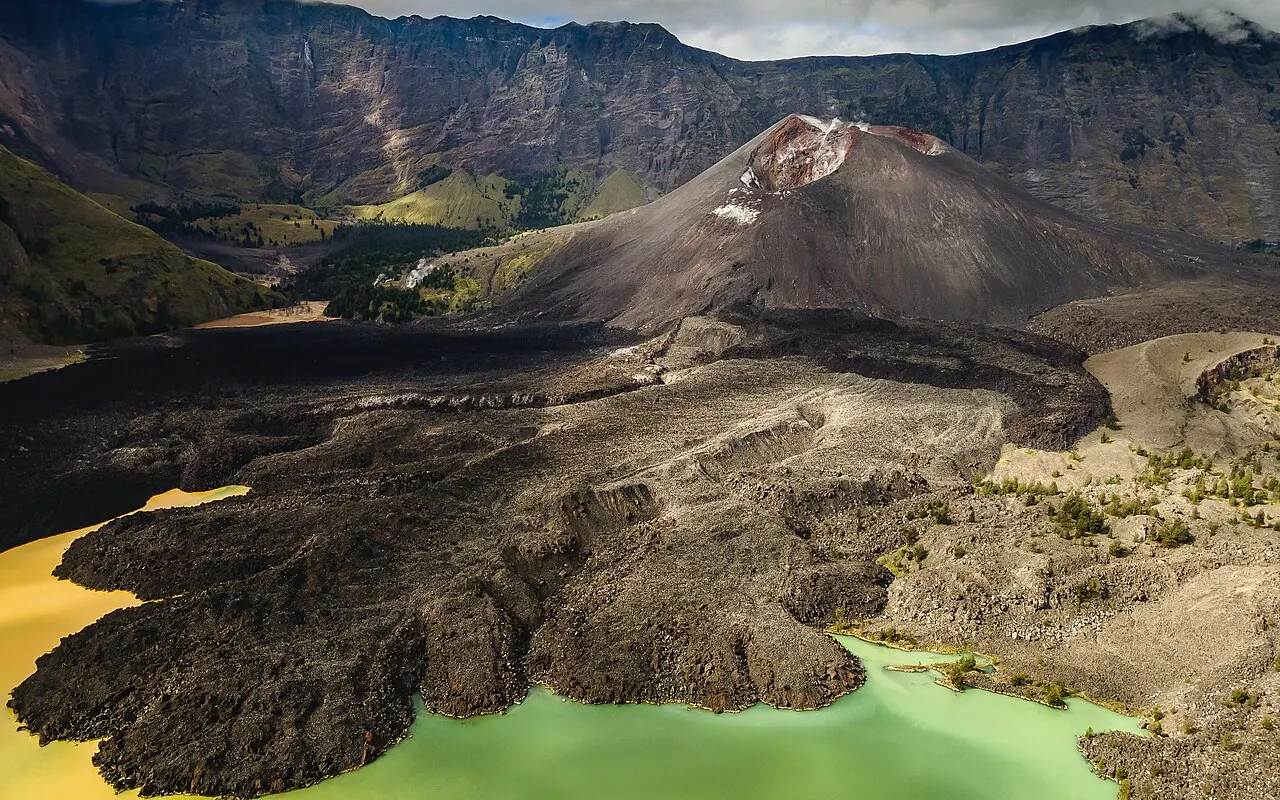
The 2D1N crater rim trek suits travellers with limited time or moderate fitness. On day one you hike for about 6 to 7 hours from Senaru to the rim, watch the sunset over the lake and the smoking Barujari cone, then camp. On day two you see the sunrise, have breakfast and walk back down to Senaru.
The 3D2N summit and lake trek is the full experience. Day one takes you from Sembalun to the crater rim camp. On day two you start around 2 am and climb for about 3 to 4 hours on loose volcanic scree to reach the summit at sunrise, then descend to Segara Anak lake and its hot springs. Day three is a climb to the Senaru rim and a long descent to Senaru. Summit day is the hardest day of the whole trip and can easily mean 10 hours or more on your feet.
How difficult is the Rinjani trek?
Rinjani needs no technical climbing skills, but it is a hard trek. Under Indonesia's new climbing grading, Rinjani sits in the most demanding category, with long steep ascents, big descents and cold nights. Reasonable fitness matters more than mountaineering experience, and an honest look at your own fitness will help you choose between the crater rim and the summit.
- Train for a few weeks before: stairs, hill walks or hikes with a loaded daypack.
- Break in your hiking shoes before the trip; new shoes and long descents are a recipe for blisters.
- Use trekking poles: they save your knees on the way down and help on the summit scree.
- Expect cold: temperatures near the summit can drop close to 0 °C before sunrise.
- Walk at a steady pace and tell your guide early if you feel unwell; turning back is always an option.
Best time to trek and the annual closure
The dry months, roughly May to September, usually give the clearest skies and the most reliable summit views. July and August are the busiest months, so permits and campsites fill up faster. From November the rain returns, afternoon cloud is more common and the trails get slippery.
Rinjani National Park (Balai TNGR) closes all hiking routes every rainy season. For 2026 the closure ran from 1 January to 31 March and the trails reopened on 1 April. The dates for 2027 are normally announced around December, so check with us before you book flights. Routes can also close temporarily because of bad weather, volcanic activity or forest fire risk: in September 2026 online booking was paused during the dry season, and the Senaru route reopened on 3 October 2026.
Permits, eRinjani and entrance fees
All Rinjani permits are booked online through eRinjani, the national park booking system, with daily quotas for each route. When you trek with an operator, the guide books the permit and registers your group at the park post. For July and August it is wise to book a few weeks ahead.
Since 3 November 2025, the entrance fee on the main routes (Senaru, Sembalun and Torean) is Rp 250.000 per person for foreign visitors and Rp 50.000 on weekdays or Rp 75.000 on weekends and holidays for Indonesians. The park has also tightened its rules since August 2025, including certified guides, a limit of four hikers per guide from January 2026, a health check before the climb and insurance requirements. Rules can change during the season, so we confirm the current requirements when you book.
Our guided treks already include the national park entrance fee and permit, so you do not need to deal with eRinjani yourself. Here is what is included and what is not:
- Included: return transfer from Senggigi, Mataram or Kuta to the trailhead.
- Included: national park entrance fee and trekking permit.
- Included: licensed guide and porters.
- Included: tents, sleeping bags and sleeping mats.
- Included: all meals on the mountain and drinking water.
- Not included: tips for the guide and porters, personal gear (shoes, jacket, headlamp) and an extra porter for your own bag.
Packing list and safety on Rinjani
- Hiking shoes with good grip (not running shoes with worn soles).
- Warm layers: fleece, insulated or down jacket, beanie and gloves.
- Light rain jacket, even in the dry season.
- Headlamp with spare batteries for the summit start in the dark.
- Daypack of about 25 to 35 litres for water, snacks and layers.
- Sun protection: hat, sunglasses and sunscreen for the open savannah.
- Personal medicine, blister plasters and a small first aid kit.
- Power bank, small towel and swimwear for the hot springs.
- Cash in rupiah for tips, drinks and snacks at the trailhead.
Stay with your guide at all times, especially on the summit ridge and near the crater edge, where the ground is loose and the drops are steep. Follow the turnaround time your guide sets, even if the summit looks close. Open fires are not allowed, so never light anything in the dry grass, and carry all your rubbish back down.
Getting to Senaru and Sembalun
Senaru and Sembalun are both in the north and east of Lombok, roughly 2.5 to 3 hours by car from Lombok International Airport. Our guided treks include pick-up from hotels in Senggigi, Mataram or Kuta Mandalika, usually very early in the morning on day one.
If you land on the day before your trek, or want to sleep near the trailhead first, a private transfer is the easiest option. Lombok Airport to Senaru costs Rp 650.000 per car (MPV), Rp 750.000 (Innova) or Rp 1.000.000 (Hiace). Lombok Airport to Sembalun costs Rp 700.000, Rp 800.000 or Rp 1.100.000 per car. A night in Senaru or Sembalun means a calmer start and more rest before the climb.
Book your guided Rinjani trek
Our Mount Rinjani Trek 2D1N to the Senaru crater rim starts from Rp 2.000.000 per person for groups of five or more (Rp 2.450.000 per person for two hikers). The 3D2N summit and lake trek starts from Rp 3.250.000 per person for five or more (Rp 3.900.000 per person for two). Send us your dates, group size and hotel on WhatsApp and we will confirm route status, permit availability and the exact price for your group, plus a fixed price per car for any extra transfers.